 1
1Ofcourse ! So stupid of me.
 1
1Rack up your brains, guys!!
1
SURYA RAMKUMAR
·2010-04-28 04:43:26
yeah answer is wrong!!!!!!!
answer this question guys::
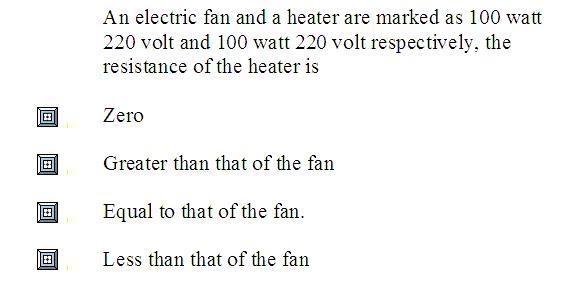
an instrument X n Y are marked as 100 W n 220 V and 100 W n 220 V respectively.the resistance of X is
(a)greater thn y
(b)equal to Y
(c)less than y
(d)zero
P.S. X n Y cn be anything LOL!!!!!!!!!!.ranging from heater to anything in the world!!![3][3][3]...now answer me[1]
 23
23see,
consider an equipment of 100 watts
now the formula that we hav Power = i2R
is related to heat
now it depends on the equipment
100 watts = power related to heat+ power related to its mechanism
( though i m not sure [3] [3] lol)
1
SURYA RAMKUMAR
·2010-04-28 04:37:42
@qwerty...
well i don happen to agree[2][2]..at constant potential difference instruments of same power rating offer equal resistance!
23
qwerty
·2010-04-28 04:36:50
yup , actually same logic as guruji [1]
23
qwerty
·2010-04-28 04:36:14
wasnt sure of my logic and hence termed it as a wild guess [4]
see take a bulb and a tubelight of same watts , bulb become more hot than the tubelight bcz the tungsten filament has considerable resistance
in this question, think conversely
1
SURYA RAMKUMAR
·2010-04-28 04:35:21
wow!!!!!wat logic.......[3][3][3]
23
qwerty
·2010-04-28 04:22:45
is it b ??? giving a wild guess [5] 
1
aposlil
·2010-04-28 04:32:51
Higher the resistance, more heat will be produced...and thats exactly the function of a heater. Fan does not produce high amt. of heat.
1
sowmya
·2010-04-28 04:29:29
No explanation was given,and even my initial impulse was to mark 'C'.
1
sowmya
·2010-04-28 04:26:34
The wild guess is correct :|
23
qwerty
·2010-04-28 04:25:53
formula use kiya t C hi a raha hai , but i feel there is something else in this question [4]